Major Responsibilities of the MOPH Administrative Unit
It has three departments directly associated with it in addition to the general administration service and the services of public health in the Mohafazat:
a- IT department:
Dissemination of Ministry’s information
Information networking with other institutions
b- Department of projects and programs:
Preparing the Ministry’s Plan of Action and related policy plans
Providing proposals for laws and decrees to meet the role of the MOH
c- Department of Control on Public Hospitals:
Newly established, follows up on the performance indicators for public hospitals.
General Administration Service
Ministry’s Post Office
Information Desk
Assigning Standards for the Bids
Issuing buyer’s certificates for drugs and equipment
Preparing the Budget
Expense Allocation
Employee’s transactions
Legal consultations for health related matters
Communication with international organizations
Issuing and renewing employees’ contracts and other certificates, including HRH of the Ministry of health various departments and peripheral units.
Services of Public Health at the Provinces
Responsible of the administrative health services of the districts under their supervision
B- Directorate of Preventive Medicine:
Includes 4 services in addition to the department of statistics:
Department of Statistics
Gathering health information from various stakeholders
Information sharing inside and outside of the ministry
Gathering statistical data and preparing statistical reports
Service of Sanitary Engineering
Setting up food and nutrition strategies for food hygiene and food born diseases and malnutrition
Conducting studies on children’s nutritional status based on the Health file information
Initiating health inspection activities and water safety studies
Insects control
Food safety
Classification of the production industry
Setting water safety standards
Service of preventive medicine:
Gathering information on mandatory reported diseases
Epidemiological surveillance and control
Setting communicable disease programs
Performing health inspection on passengers (In and out of Lebanon)
Vaccinating Lebanese people travelling to high risk areas
food inspection and sanitation on airplanes
Initiating Epidemiologic Surveillance and assuring Primary Health care
Training medical doctors on the principles of preventive medicine
Service of Social Health
Setting and implementing health education programs
Initiating school health programs in collaboration with the Ministry of Education
Training health workers in public and private sectors
Preparing health education and promotion materials
Responsible for Safe motherhood and child health programs
Responsible for conducting studies and follow-ups in schools
Responsible for performance of midwives undergoing training
Training of Human Resources for Health in general
Issuing and distributing the health file for children and reviewing its content
About 200 Primary health care centers are spread all over the Lebanese territory.
Primary Health care centers provide a basic affordable package of health services including: General Medicine - Pediatric Including Immunization services - Gynecology – Cardiology- Dental services In addition to the screening for non communicable diseases, in collaboration with WHO, and for acute malnutrition, in collaboration with UNICE, Reproductive Health in collaboration with UNFPA . .
The Primary Health care centers undergo accreditation process by Accreditation Canada to ensure the quality of their health services.
The Primary Health care centers use a specialized health information system (HIS ) .
The Ministry of Public Health, and through the Emergency Primary Healthcare Restoration Program (EPHRP) covers 150,000 vulnerable Lebanese with free Preventive Health Services in 6 packages, (through 75 PHC centers):
children and Adolescents (0-18 years)
females (19 years and above)
males (19 years old and above)
Non-communicable disease – Diabetes mellitus
Non-communicable disease - Hypertension
Reproductive Health
Activities and Achievements: Nearly half a million (0.5 Million) children under five are vaccinated on the Lebanese territory during each national immunization campaign to contribute to the eradication of polio and measles with the support from the WHO and UNICEF.
A postage stamp marking the 30th anniversary of the polio program was launched in 2016.
Lebanon is the fifth country in the world to receive accreditation for the Vaccine Cold Chain. An exemplary Cold Chain system is maintained by equipping the vaccine distribution and health centers with solar, gas and electrical refrigerators, the equipment provided with the support of the European Union and UNICEF.
Each year about 77,000 children are vaccinated in health centers, against: Measles, Rubella, Mumps, Pertussis, Whooping cough, Tetanus, Hepatitis B, Hemophilus influenza B and Pneumococcal conjugate.
Five vaccination centers at the Lebanese borders, and four vaccination centers within UNHCR registration sites were established to provide vaccination and malnutrition screening services.
Service of Occupational Health
Deals with diseases and risks of the job and job-related activities
C- Directorate of Medical Care:
Includes two services:
Service of hospitals, dispensaries, and medical professions
Handling records of patients treated at the expense of MOH
Setting and controlling contracts of the MOH with Health service providers
Performing medical audits on hospital bills
Issuing certificates of practice for medical professions
Issuing certificates for health facilities
Quality control on medical facilities
Service of Pharmacy
Issuing certificates related to pharmacies and pharmacists’ practice
Drug pricing
Drug industry management and control
Narcotic drugs’ imports, distribution, and statistics
Medicinal imports/exports
Drug registration and control
Registration of non-medicinal health-related items
Pharmacies’ and drugstores’ inspection
Controlling fraud in the pharmaceutical industry
It is worth noting that some of the previously mentioned departments are almost dormant, and very few, if any, activities are performed, either due to the lack of personnel or motivation, or to the lack of funding. In addition, in 1996, a decree was issued to stop employment in the public sector, which resulted in overloaded personnel, with high average age structure and many neglected essential activities.
A new organizational structure of the MOPH is proposed, and is currently waiting for legislative measures to take effect.
In addition to these departments, there are various committees that were established according to their specialized roles:
Medical audit committee
Prosthetic committee
Committee of control of communicable diseases
Open heart committee
Tobacco control committee
Drug committees
Permanent Medical Committee
Official Medical committees (1 for each Mohafazat)
The Joint Programs between the MOPH, WHO and YMCA
Currently, there are 5 programs running, namely the National AIDS Program (NAP), the Tuberculosis Program (TB), Non-Communicable Disease Program (NCPD), Injuries and Accidents Program, Drugs registration and control program.
In addition to these programs, there is the YMCA contract with the MOPH to deliver drugs for chronic diseases all over Lebanon.
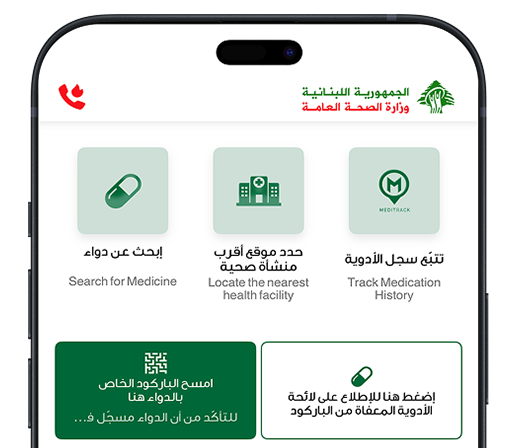
Download the new version of the MOPH app
for the latest updates on Coronavirus.
The new version of the MOPH APP will provide you with all the reliable information on COVID-19 with ongoing update of the confirmed cases and data. If you are showing any symptoms, the “Symptoms Checker” will be your self-help guide to assess them.